How to Revive a Closed-Lost Deal: Email Templates

Most Closed-Lost deals aren’t truly lost.
Most deals are often marked lost for reasons that have nothing to do with fit: budget cycles, internal priorities, existing contracts, or leadership changes.
Reps simply forget to follow up, or if they do, it's completely without context. "Just following up" falls on deaf ears with your buyers.
This guide focuses on email templates for reviving Closed-Lost deals in a way that feels relevant, timely, and grounded in real buyer context reminding them of their priorities and why it's important to unblock a project.
When a Closed-Lost Deal Is Worth Reviving
Before writing any email, you need to confirm why the deal was lost.
If the deal was lost due to poor ICP fit, missing a core product capability, or price mismatch, it should not be revived.
As a rule of thumb, if fewer than 30% of your closed-lost deals were timing-related, you won't see that much lift from sending these emails.
Closed-Lost revival works best when deals were lost due to:
- timing or budget cycles
- incumbent renewal windows
- internal reprioritization
- security or procurement delays
- “check back after X ships / hires / changes”
How to Structure a Closed-Lost Revival Email
High-performing revival emails follow a simple structure:
1. Observation: What’s happening at their business right now?
2. Hypothesis: What does that likely mean for priorities or pressure?
3. Offer: What specific value does a conversation unlock now?
This structure keeps messages grounded.
Closed-Lost Deal Email Samples
1. Budget or Timing Reset
Use when: the buyer explicitly mentioned a future budget window.
Hope you're having a great start to the new year, Amy!
When we spoke in September, you shared how your offshore team analysis quality was shoddy and you wanted to bring it in house. We paused because of the tech freeze but you said we should revisit in January with budget resets. I noticed you’re hiring for finance analysts right now. Our AI Excel plugin should be able to automate 30-40% of what they
Would it make sense to reconnect briefly to see if this is back on the table — or has timing shifted again?
2. Incumbent Contract or Renewal
Use when: the deal paused due to an existing vendor.
Hi Peter,
Last we spoke, you were pretty excited about PiedPiper but mentioned that you still had 5 months left in your Hooli contract and your VP, Gilfoyle, wanted to see if you could resolve existing SLA issues with them. Did they end up improving uptime?
Now that we're closer to your renewal with them, wanted to see if you're still evaluating alternatives or happy with what's in place.
3. Leadership Change or Internal Reset
Use when: decision-making paused due to organizational change.
Hi Aditya,
When we last spoke, you were waiting for new eng leadership before making any drastic changes to your proxy infrastructure even though it was costing you over $1.2M a year to maintain and agreed our solution would be a quick rip and replace.
I noticed a new VP Eng, Jackie, started recently, and imagine she wants to evaluate some easy wins like this.
Worth a quick check to see if this is back on the radar?
4. Product Gap Resolved
Use when: the deal stalled due to a missing capability
Hey Jen,
When we chatted 2 months ago, you were really excited about Acme's contact enrichment but couldn't move forward because we didn't integrate with Salesforce and it would have been too much friction to do manual data uploads.
We just shipped our Salesforce integration last week so I wanted to see if we should chat again assuming you're still struggling with contact data quality.
What to Avoid in Revival Emails
Avoid language that signals randomness or forgetfulness:
- “Just checking in”
- “Circling back”
- “Bumping this thread”
These phrases imply the follow-up is arbitrary, which collapses trust.
Final thoughts
Closed-Lost revival isn’t about sending more emails.
It’s about showing up at the right moment with the right context.
When done correctly, many teams recover 10–15% of timing-based closed-lost deals without increasing outbound volume or headcount.
The first step is understanding the size of the opportunity you're sitting on.
Our free pipeline teardown tool calculates your recoverable pipeline, generates sample win-back emails for your company, and scores your current closed-lost maturity.
It takes about 60 seconds and there's no form.
When you're ready to stop doing this manually, we can help — from reminding your reps to drafting context-first outbound for them, automatically.
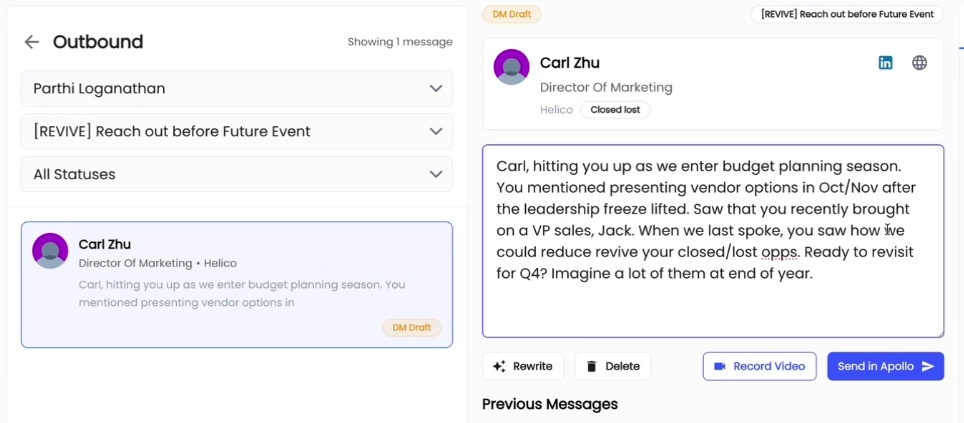
Outbound drafted automatically for closed/lost deals
Subscribe to newsletter
No-BS GTM strategies to build more pipeline in your inbox every week
Related Reading
Some other posts you might find helpful