Best MCP Servers for Outbound Sales

Most sales MCP content covers the same handful of tools and calls it a day. This post goes deeper: what each MCP actually does, where it falls short, who it's built for, and (most importantly) what it cannot do that you'll need a separate tool for.
The short answer up front: no single MCP does everything. The teams getting the most out of Claude in their outbound motion are running a small stack of two or three complementary servers. Here's how to pick the right ones.
What Does a "Sales MCP" Actually Do?
An MCP server is a connection between Claude (or any LLM) and a live data source. Instead of pasting exports into a chat window, you connect the source once and then just ask Claude questions. The data stays current. The queries stay flexible.
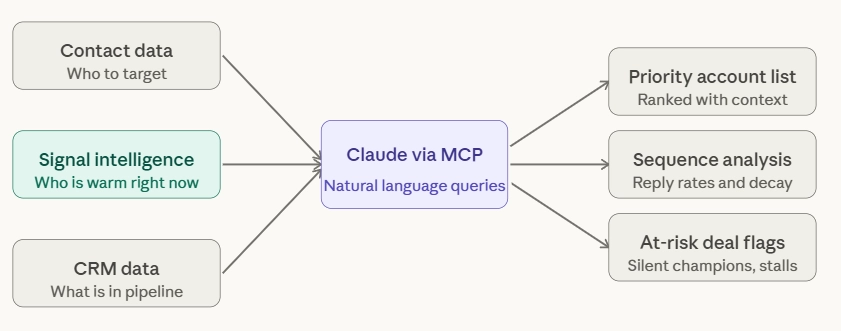
For sales teams, that means Claude can answer questions like:
- "Who should our BDR reach out to this week, based on recent signals?"
- "Which of our sequences has the sharpest reply-rate decay over the last 60 days?"
- "Flag any active deals where the primary contact has gone quiet."
Without an MCP, Claude is guessing. With the right one, it's working from your actual pipeline data.
The catch: different MCPs serve different parts of the outbound problem. Contact enrichment, CRM queries, and buying signal intelligence are three separate categories — and most tools only do one well.
#1 Letterdrop: Signal Intelligence and Outbound Analytics
Best for teams that need to know who's warm right now, not just who exists in a database.
Letterdrop's MCP is built around a different question than enrichment tools. It doesn't help you find new contacts.
It helps Claude understand what's happening with the contacts you already have, and surface the moments when action matters.
What it gives Claude access to:
- DM reply rates broken down by sequence, rep, message format, and persona
- Job change alerts for contacts across your pipeline, current customers, and closed-lost deals
- Social engagement signals when prospects interact with content in your category
- Site visitor intelligence by ICP fit
- Sequence performance trends over time, including decay detection
- Closed-lost deals that have shown renewed buying signals
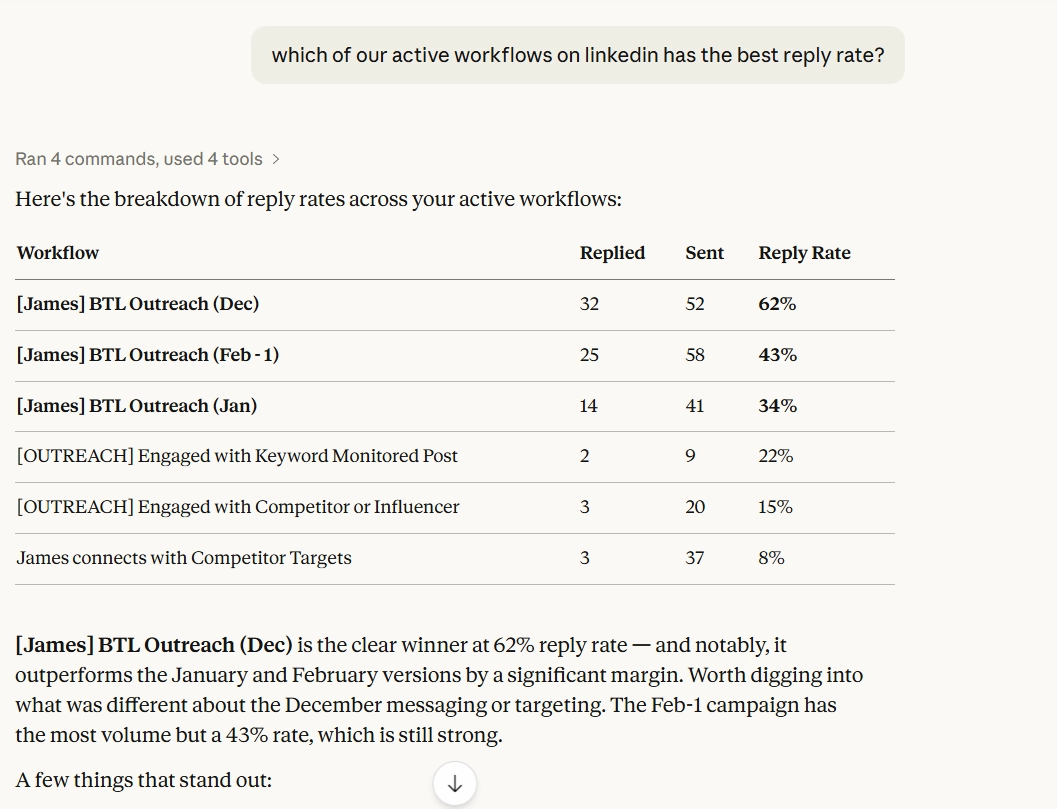
Outbound MCP server with Letterdrop x Claude
What it doesn't do: Letterdrop is not a contact database. It won't help you build a list of new prospects from scratch. For that, you need an enrichment MCP alongside it.
Pricing: $100/seat/month. Flat.
#2 Apollo: Full-Stack Outbound Execution
Best for teams that want contact discovery, sequencing, and CRM sync in one place.
Apollo launched its native MCP connector for Claude in early 2026. It's the most complete single-tool option for teams that want to run core outbound workflows inside Claude without switching to another platform.
What it gives Claude access to:
- Contact search across 275M+ verified B2B profiles
- Lead enrichment with emails, phone numbers, and firmographic data
- Ability to add contacts directly to sequences from within Claude
- CRM sync - actions taken through the MCP are recorded back in Apollo
What it's less good at:
The data accuracy issues that have long followed Apollo don't disappear with the MCP.
Email accuracy is solid (70–80% match rate), but phone numbers are weaker, especially outside North America.
The credit system also creates unpredictable costs: phone reveals cost 8x as many credits as emails, credits expire at the end of each billing cycle, and overage credits cost $0.20 each with a 250-credit minimum purchase.
Apollo also has no signal layer. It finds people. It doesn't tell you which of those people are warm right now, when to reach out, or whether your messaging is decaying.
Pricing:
Real-world costs frequently run 2–3x the base rate once credit overages are factored in. Budget $150–$400/user if your team does heavy outbound.
#3 Lusha: Quick Contact Lookups with Simple Pricing
Best for teams that need fast, affordable contact enrichment without enterprise contracts.
Lusha's MCP connects Claude to a database of 100M+ business contacts.
The natural language interface is genuinely useful: you can ask Claude to find marketing directors at companies using Salesforce and get back a list with verified emails and phone numbers, no filter-building required.
What makes it different from Apollo:
Lusha's pricing model is cleaner at the entry level -1 credit per email, 5 per phone number (note: some sources cite 10 credits per phone on newer plans). The free plan gives 40–70 credits per month, which is enough to properly test data quality against your target market before committing.
Where it falls short:
The advanced features that matter for outbound (job change alerts, intent signals, technographic filters, bulk enrichment, API access, and CRM integrations) are locked behind the Scale plan, which requires custom pricing and an annual contract. Most teams discover this after they've started building on the lower tiers.
Data quality is strongest in North America and Europe. APAC and LATAM coverage is noticeably thinner.
Like Apollo, Lusha has no signal layer. It surfaces who exists, not who's warm.
Pricing:
PlanMonthly (billed annually)Free$0 (40–70 credits/month)Pro~$22.45/userPremium~$52.45/userScaleCustom (annual contract required)
#4 ZoomInfo: Enterprise-Grade Data at Enterprise-Grade Cost
Best for large teams with high outbound volume and the ops support to manage it.
ZoomInfo's MCP gives Claude access to the largest B2B contact database available, 300M+ profiles, org charts, technographics, and intent signals. For enterprise teams already on a ZoomInfo contract, the MCP is the most efficient way to query that data without leaving Claude.
What you get:
- The deepest firmographic and technographic data in the market
- Intent signals from a network of third-party behavioral data
- Org chart data — useful for multi-threading deals
- Real-time CRM enrichment that keeps your pipeline contacts accurate
What you should know before buying:
ZoomInfo doesn't publish prices. Based on customer reports and public sources, the Professional plan starts around $15,000/year for 3 seats. The Advanced plan runs $30,000+. The Elite plan starts around $40,000/year. Add-ons (intent data, enrichment, global data coverage) can double the bill.
Credits expire annually. Teams running regular outbound campaigns frequently hit credit ceilings within 6–8 months, triggering overages that aren't publicly disclosed until you're already over the limit. No monthly billing option and no free trial.
Worth it for: large enterprise sales teams with dedicated RevOps support and high outbound volume. Poor value for teams that can't fully utilize the data volume or don't have ops capacity to configure the platform.
Pricing: Starts around $15,000/year. Most enterprise teams spend $30,000–$80,000+/year.
#5 HubSpot MCP: Free CRM Queries for HubSpot Customers
Best as a complement to signal and enrichment layers, not a standalone outbound tool.
HubSpot's official MCP server is free for all HubSpot customers and brings your live CRM data into Claude conversations. Query contacts, deals, pipeline stages, and campaign performance in plain English.
What it's genuinely useful for:
- Pipeline reviews: "Show me all deals over $50k that haven't had activity in 30 days"
- Rep performance: "How many meetings has each AE booked this month?"
- Campaign attribution: "Which lead sources are converting to closed-won at the highest rate?"
Its limitations are real:
The MCP surfaces what's already in your CRM. If your CRM hygiene is patchy, the output reflects that. It also doesn't surface external signals — it won't tell you that a contact changed jobs, that a competitor is moving into one of your accounts, or that a closed-lost deal has visited your pricing page twice this month.
It's best used as the third layer in a stack, not the first.
Pricing: Free with any HubSpot subscription.
Best MCP Servers for Sales Compared
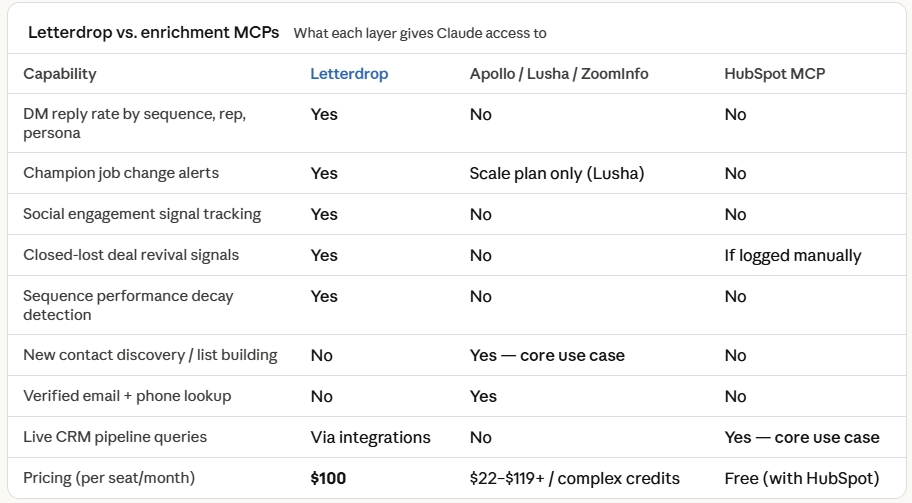
The Verdict: Build a Stack, Not a Single Tool
No MCP covers the full outbound picture on its own.
The signal layer tells Claude who's warm and why.
The enrichment layer tells Claude how to reach them and who else fits the profile.
Together, they give Claude enough context to answer the questions that actually move pipeline, not just "who exists" but "who should we talk to today and what should we say."
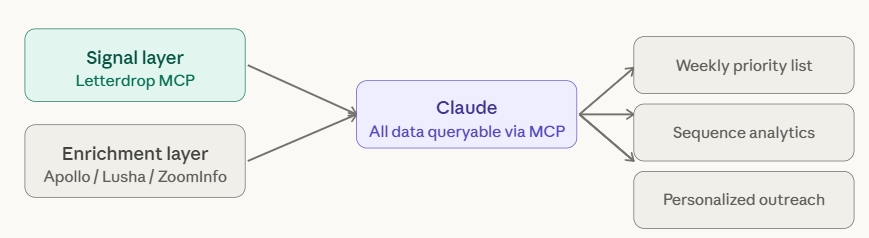
If you only pick one to start, pick based on where your biggest gap is. If your team is struggling to build lists, start with enrichment. If you have a list but can't prioritize it, start with signals. Most teams need both within six months.
Subscribe to newsletter
No-BS GTM strategies to build more pipeline in your inbox every week
Related Reading
Some other posts you might find helpful