Letterdrop vs Clay for Competitor Intelligence

Clay and Letterdrop live in the same outbound stack. Both touch prospect data. Both integrate with Salesforce, HubSpot, and Slack. So the question of whether you need one, the other, or both is fair.
The answer comes down to what problem each tool is built to solve. They are solving different ones.
What Clay Does
Clay is a data enrichment and workflow automation platform. You bring a list of contacts or companies, and Clay enriches it by querying 100+ data providers in sequence - stopping when it finds a valid result. A well-built Clay table can move email coverage from around 50% to 80-90% while keeping cost tied to results.
Beyond enrichment, Clay lets you build conditional logic, run AI research via Claygent, and push enriched records directly into your CRM or sequencing tool.
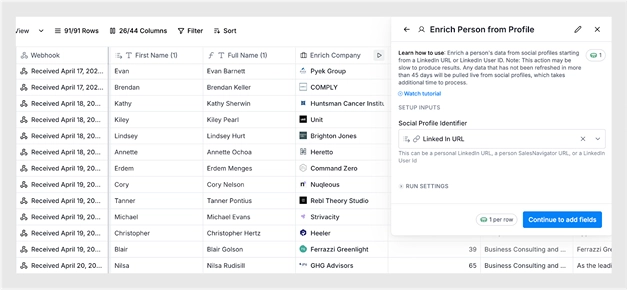
Enriching a contact with Clay
For teams running personalised outreach at scale, it meaningfully reduces manual research time.
Clay also surfaces intent signals from G2 and Bombora, which can be used to score and filter leads inside the same workflow. For RevOps teams, the appeal is clear: one platform that enriches, scores, and routes leads without stitching together separate tools.
Clay is genuinely excellent at what it does.
Letterdrop x Clay for Full Enrichment
Clay's intent signals - G2 profile views, Bombora surges - are research behaviour signals. Paired with Letterdrop, you can learn:
- Which competitor is actively selling into that account
- Which specific contact is driving the evaluation
- When the conversation started or how far along it is
Letterdrop monitors public signals to identify contacts in active sales cycles with your competitors. More specifically:
- A named contact with their title and company
- The competitor involved
- The cycle stage
- Confidence score
- Recommended next steps (outreach, customer defense, marketing air cover)
- Delivered to Salesforce, HubSpot, or Slack the same day
Teams that have moved from G2 intent to Letterdrop describe the same shift: instead of chasing signals 30 to 45 days stale, they are reaching accounts on day one of a competitor evaluation while the conversation is still open.
On average, 1 in 3 contacts surfaced is already an open opportunity, a winnable closed-lost, or a renewal at risk. Leads convert to meetings at 3x the rate of cold outreach.
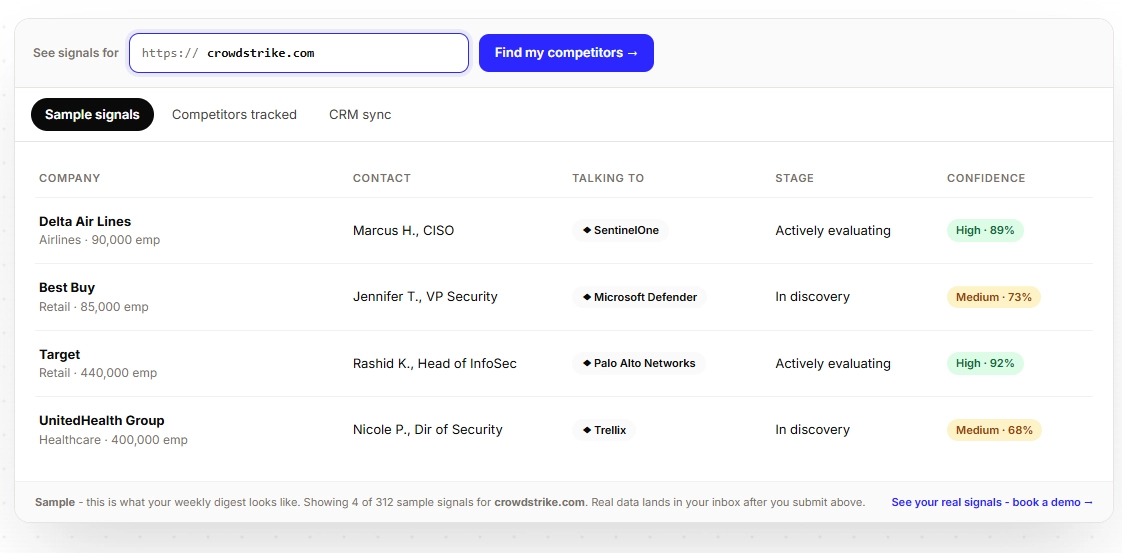
Find in-cycle deals with Letterdrop
Clay's Own Team Uses Letterdrop
Clay is a Letterdrop customer. Their sales team uses Letterdrop to surface competitor evaluations and booked 35% more enterprise pipeline as a result.
The most effective setup is Letterdrop as the signal layer, Clay as the enrichment layer.
Letterdrop identifies a contact in an active competitor evaluation. A webhook sends the details to Clay. Clay enriches the record - verified email, phone number, personalised first line - and pushes it to Salesforce or your sequencing tool. The rep gets a Slack alert with a complete, ready-to-send contact. No manual research.
Use Clay when contact data quality and workflow automation are the constraint. Use Letterdrop when timing and competitive visibility are the constraint. Use both when you want the complete motion.
Subscribe to newsletter
No-BS GTM strategies to build more pipeline in your inbox every week
Related Reading
Some other posts you might find helpful