How to Find Buyers Evaluating Your Competitors (Before the Deal Closes)

Your competitor's reps are out right now, building relationships with buyers who are actively evaluating software in your category. You are not guessing who is in market. You are not inferring it from funding rounds or job changes. You know, because competitor activity in public channels just told you.
This guide covers how to collect those leads, how to reach them before the competitor closes, and how to automate the entire process so it runs without manual effort.
Why Competitor Rep Activity Is Your Best Source of In-Market Leads
Good sales reps multithread. When they open a new deal, they engage with the champion and at least one other stakeholder at the account across public social channels. That is standard practice.
It is also, from your perspective, a real-time signal that a buying cycle has just opened at that company.
Compare this to the signals most teams rely on. Funding rounds and new hire announcements are visible to every vendor simultaneously. By the time you send an email referencing a Series B, the prospect has received twenty identical emails from your competitors. The signal is real but the edge is gone.
Competitor rep engagement activity is different on both dimensions. It is a direct indicator of an active buying cycle, not a proxy for one. And it requires infrastructure to collect systematically, which means the teams who build that infrastructure are reaching buyers that their competitors do not even know are in play.
The only thing that would give you better intelligence is access to your competitor's CRM. This is the next best thing.
What the Play Looks Like
You sell a product that competes with, say, a spend management platform.
A competitor rep begins publicly engaging with a VP of Finance at a mid-market SaaS company. That VP is almost certainly evaluating or about to evaluate software in your category. You reach out before the competitor has run a full demo cycle.
The same logic applies to any competitive pair in any category. You monitor activity from reps at Competitor A to find in-market buyers who have not yet heard from you. The competitor's pipeline becomes your prospecting list.
The structure: track competitor rep activity across public channels, collect every new ICP-matching signal, qualify against your criteria, and reach out within 48 hours with a message specific to the competitive context.
Part 1: How to Build This Manually
You do not need heavy tools to run a version of this today. You need a way to monitor public social activity, 20 minutes of setup, and the discipline to check it daily.
Phase 1: Build Your Competitor Rep Watchlist
Identify the reps you want to track. Go to each competitor's public page and identify their quota-carrying reps: Account Executives, Account Managers, and similar roles. Aim for 10 to 20 reps per competitor. The more reps you track, the more buying signals you collect.
Start monitoring their public activity. Once you have your watchlist, you can begin tracking their public social engagement: who they are publicly interacting with, which companies they are engaging, and which new contacts appear in their orbit. This is all observable from public signals.
Build a tracking spreadsheet. Columns: rep name, competitor, signal date, contact name, title, company, ICP match (Y/N), date spotted, days since signal, action taken, outcome.
PS - you can do this using Letterdrop. Try it free now.
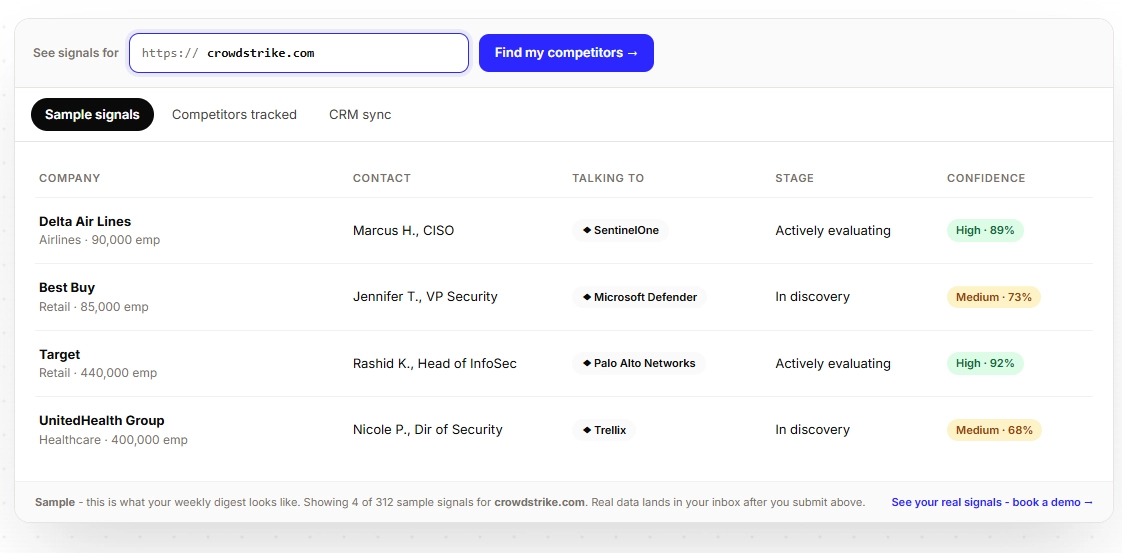
See who is starting deals with your competitors
Phase 2: Monitor and Qualify
Check your signals daily, not weekly. Public social signals move fast. A weekly review means you are acting on leads that have already gone cold. Build the habit: every morning, review recent activity from the reps on your watchlist and flag anything that matches your ICP.
Qualify every new signal immediately. When you spot a new contact in a competitor rep's orbit, look them up: title, seniority, company size, industry. Does this person match who you sell to?
If two or more people at the same company appear in the same competitor rep's activity within 14 days, move that account to the top of your list. A single contact is a lead worth pursuing. Two or more at the same company is a deal that is almost certainly open.
Cross-reference your CRM before acting. If an AE already owns the relationship, flag the signal to them as competitive intel. If the account is open, route it to the right rep with the signal context attached.
Phase 3: Write the Intercept Message
Teams using messaging written specifically for this signal type see 3.4x higher meeting rates compared to teams running generic cold outreach regardless of trigger. The signal gives you specific context about what this buyer is evaluating right now. Your message needs to use it.
Do not reference how you got the signal. Simply say you noticed they may be evaluating solutions in this category. Keep the framing on what you know about their likely needs, not on your monitoring methods.
The message structure that converts:
Subject line: Short, curiosity-driven, no method revealed. Examples: "[Category] a priority this quarter?" or "Quick question on [category]."
Opening: Anchor to their world, not yours. Reference something specific to their role, their business, or a problem common to buyers in their position.
Body: One or two lines on how you are positioned differently from the specific vendor you know they are evaluating. Focus on the tradeoff they will face with that competitor, not a generic feature list.
CTA: Ask for something small and specific. A 15-minute comparison call, a relevant benchmark from similar companies, or a direct question that invites a reply.
Set a response SLA. If a signal fires today, the message goes out today or tomorrow. Not next week. Treat each signal like an inbound lead: it gets a response window and a named owner.
Letterdrop monitors public buying signals continuously across your full competitor set.
When a qualifying signal fires, the right rep gets an alert within hours: "A decision-maker and end user at [Company] have been observed in a competitor rep's orbit in the last 3 days." From there, your outreach sequence fires.
Subscribe to newsletter
No-BS GTM strategies to build more pipeline in your inbox every week
Related Reading
Some other posts you might find helpful