Competitors Are Poaching Your Customers, Here's How to Know

Most churn follows the same pattern. An account goes quiet. A QBR gets rescheduled. Then on a call that was supposed to be routine, your champion mentions they have been evaluating alternatives.
By that point a competitor has already run a demo, reached multiple stakeholders, and started shaping how your customer thinks about what better looks like. You are playing defense in an evaluation you did not know was happening.
B2B companies churn around 24% of their customers annually, and spikes in churn are typically associated with a competitor actively poaching accounts.
The consistent finding across sales teams: by the time you realise a customer is going to leave, the relationship is often already beyond salvage.
The window where you could have acted cheaply closed weeks ago.
Why Your Existing Customers Are a Target
Your customer base is the highest-quality prospecting list your competitors have. Every account you have won has already crossed the hardest hurdle: budget allocated, use case validated, willingness to pay proven.
Competitors know this and run systematic outbound against your accounts.
Most CS and AM teams are not running a symmetric play. They are waiting for renewal conversations to surface dissatisfaction that has been building for months.
The Signals to Watch
Competitor reps interacting with contacts at your accounts
When a competitor's rep reaches out to or friends a stakeholder over socials at one of your accounts, a sales cycle has very likely opened.
When two or more people at the same company receive this kind of outreach from the same competitor rep within 14 days, the probability of an active evaluation jumps to 84%.
The question is not whether this is happening. It is whether you find out in week one or week six.
Interaction with competitor content
A contact at one of your accounts publicly interacting with competitor content is an earlier, softer signal. They are in research mode. No vendor has shaped their thinking yet. This is your best window because you can show up before the evaluation starts.
Do not mention the competitor. Share your own perspective on the same topic. You are entering their awareness before they start talking to sales teams.
Your own interactions going quiet
A previously responsive customer going dark is a lagging signal. By the time you notice it, the competitor has usually already been in conversation for a while. Still worth acting on, but not the early warning you want.
How to Get Alerts When a Competitor Poaches A Customer
Most revenue teams already have tooling that is supposed to catch this. The problem is that none of it is built to see competitive activity at the contact level.
Salesforce tells you an account is at proposal stage with a last touch eight days ago. Gainsight tells you NPS is holding and engagement looks healthy. 6sense flags that a company is researching your category.
None of these tell you that a named contact at that account is already in a late stage sales cycle with a competitor right now.
Salesforce does not know. Gainsight does not know. 6sense does not know. By the time the lagging indicators in those tools catch up, the deal is often already lost.
The signal that actually matters is earlier and more specific: which individual at which account is actively being sold to by which competitor, and when did it start. That is the information that lets you act in time.
Automated alerts
At scale, manual monitoring has three failure points: coverage, timing, and routing.
The right setup delivers an alert the same day a qualifying interaction is detected, routes it to the CS or AM who owns the account, and gives them enough context to act immediately.
Teams who respond within 24 to 48 hours of a competitive signal at an existing account convert a meaningful share of those situations into proactive renewals or expanded relationships. Teams who find out at the renewal meeting are already losing.
Letterdrop does exactly this, tracking competitive activity across your accounts and routing same-day alerts to the right person.

How Letterdrop can help track competitors for your reps
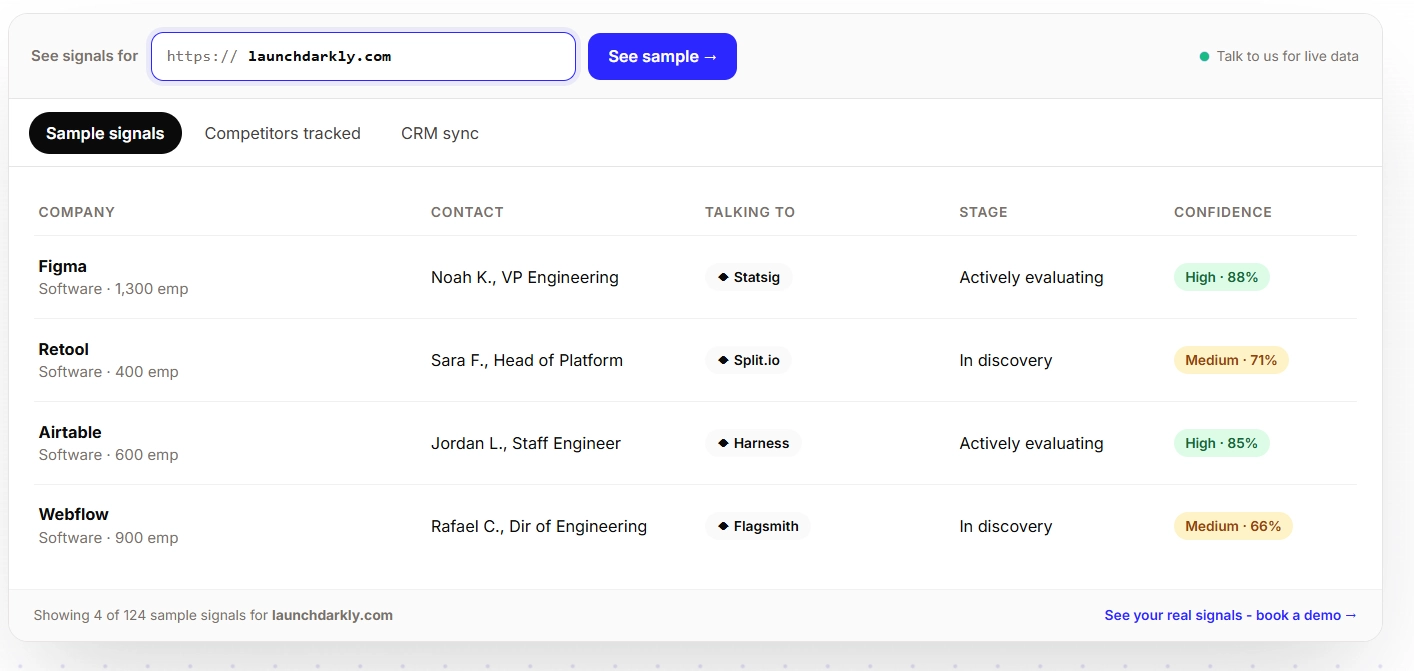
Letterdrop has alerts for when competitors are poaching your customers
What to Do When You See the Signal
If a competitor rep is actively reaching out to your account contacts: do not wait for the next scheduled call. Reach out to your champion now. Do not mention the competitor.
Lead with value: a relevant case study, a new use case, a product update that addresses something they have raised. You have a relationship advantage. Use it before it erodes.
If it is content interactions only: share something relevant to the same topic this week. Not a pitch. Something that reinforces you are the authoritative voice on the problem they are researching.
If you are seeing multiple signals from the same account: treat it as a live competitive deal. Escalate internally, consider an executive touch, and give your champion the framing they need to advocate for you if an evaluation is already underway.
Set up Alerts Today
The signal is not invisible. It is just invisible to teams who have not built the infrastructure to see it. Fifty warm intercepts outperform five thousand cold spray and prays, and that applies to retention as much as it does to new pipeline.
Subscribe to newsletter
No-BS GTM strategies to build more pipeline in your inbox every week
Related Reading
Some other posts you might find helpful