Bombora vs 6Sense for Competitor Monitoring

If you are trying to decide between 6sense and Bombora, or you are already paying for one of them and wondering why pipeline has not moved, this post will save you some time.
Both tools are built around the same core idea: aggregate signals from across the web to identify companies that are researching topics relevant to your product category, and surface those companies to your sales team as "in-market."
It is a genuinely useful idea. It is also not competitor monitoring, and the gap between what these tools tell you and what a sales team actually needs to intercept a competitive deal is larger than most buyers realise before they sign.
Here is an honest breakdown of what each tool does, where both fall short for competitive use cases, and what the signal actually looks like when it is specific enough to drive same-day outreach.
6Sense for Competitor Monitoring
6sense is an account-level intent platform built around its "Revenue AI" model.
It ingests signals from its publisher network, third-party data partners, and your own first-party data, then uses that to score accounts by likelihood to be in an active buying cycle.

Tracking accounts in 6Sense
For large enterprise sales teams running account-based marketing programs, it gives a useful layer of prioritisation on top of existing outbound.
Where it falls short for competitor monitoring specifically:
- It tells you a company is researching your category. It does not tell you they are talking to a specific competitor. 6sense surfaces intent based on content consumption patterns. If employees at Acme Corp are reading articles about CRM migration, that registers as intent signal. Whether they are actively in a demo cycle with Salesforce, HubSpot, or both, or just doing background research with no immediate purchase intent, is not something 6sense can tell you.
- The signal is shared. The publisher network that feeds 6sense is available to multiple vendors. When an account surges on a category keyword, your competitors see the same flag. The intent data becomes a race, and you are running it alongside everyone else in your category.
- Contact-level specificity is limited. 6sense can identify that a company is in-market and surface contacts within that company. But it cannot tell you which specific contact is driving the evaluation, who they are talking to, or how far along the conversation is. Your BDR still has to identify the buyer, make contact cold, and hope the timing works out.
Bombora for Competitor Monitoring
Bombora pioneered the B2B intent data space with its "Company Surge" product. It works by tracking content consumption across its co-op network of B2B publishers.
When a company's employees consume content on a topic at a rate significantly above their baseline, Bombora flags it as a surge.
The co-op model gives Bombora broad coverage. It is used as a data layer by dozens of other platforms including Salesforce, HubSpot, and many intent tools that resell or incorporate Bombora data.

Account insights in Bombora
Where it falls short:
- It is the most account-level tool in this space. Bombora tells you a company is surging on a topic. It does not identify which individual at that company is researching, does not tell you which vendor they are talking to, and provides no mechanism for routing to the right rep with the right context.
- It measures research, not buying cycles. A company whose employees are reading a lot about cybersecurity may be preparing for a board presentation, conducting a market analysis, or actively evaluating vendors. Bombora cannot distinguish between these. The signal indicates interest in a topic, not intent to buy.
- The lag problem. Because Bombora is aggregating across a network of publishers, there is inherent latency in the data. By the time a surge is identified, scored, and delivered to your sales team, the window where outreach would have felt timely has often already passed.
When 6sense and Bombora Are Worth It
6sense is most valuable for enterprise ABM programs where you are running coordinated advertising, outbound, and content plays against a named account list.
If your sales cycle is six to eighteen months and you are trying to time touchpoints across a long journey, account-level intent layered into an ABM platform makes sense.
Bombora is most useful as a data layer feeding into other tools. If you are already using a platform that ingests Bombora data, the incremental lift on prioritisation is real, even if the individual signal is not specific enough to drive outreach on its own.
The Shared Problem: Account-Level Intent Cannot Drive Competitive Outreach
Both tools have the same fundamental limitation for competitive use cases. They are built to answer the question "which companies are interested in our category?" They are not built to answer "which specific person at which company is in an active evaluation with a competitor right now?"
That distinction matters more than it sounds.
When 6sense or Bombora flags an account as in-market, you know a company is probably researching your category.
You do not know who to contact, which competitor they are talking to, whether they are in an active evaluation or doing background reading, or what your message should say that would be different from any other cold outreach.
This is not true competitor intelligence, which if you want to stay ahead of the curve, needs to change.
When 6sense and Bombora Are Worth It
To be direct: both tools have legitimate use cases. Neither is a scam.
6sense is most valuable for enterprise ABM programs where you are running coordinated advertising, outbound, and content plays against a named account list. If your sales cycle is six to eighteen months and you are trying to time touchpoints across a long journey, account-level intent layered into an ABM platform makes sense.
Bombora is most useful as a data layer feeding into other tools. If you are already using a platform that ingests Bombora data, the incremental lift on prioritisation is real, even if the individual signal is not specific enough to drive outreach on its own.
Neither is a substitute for competitive monitoring. If the question you are trying to answer is "who is talking to my competitors right now," account-level intent data will give you a long list of companies that might be in your category and no reliable way to prioritise or personalise outreach from it.
What Competitor Monitoring Actually Looks Like
The most reliable signal for competitive deal interception does not come from a publisher co-op. It comes from your competitors' own sales activity.
When a competitor AE interacts with or friends a buyer on socials for example, they are showing you an open deal.
That is the difference between intent data and competitive intelligence. Intent data tells you who might be interested. Competitive intelligence tells you who is already in a conversation you should be part of.
How to Put This on Auto Pilot
Letterdrop monitors this activity continuously across the web.
When a competitor's rep friends or interacts with a contact matching your ICP, Letterdrop flags it, enriches the contact, and delivers it to your CRM or Slack the same day with context and suggested outreach.
If the account is already in your pipeline, it routes to the owning rep as a competitive heads-up. If it is net-new, it goes to the right BDR ready to act.
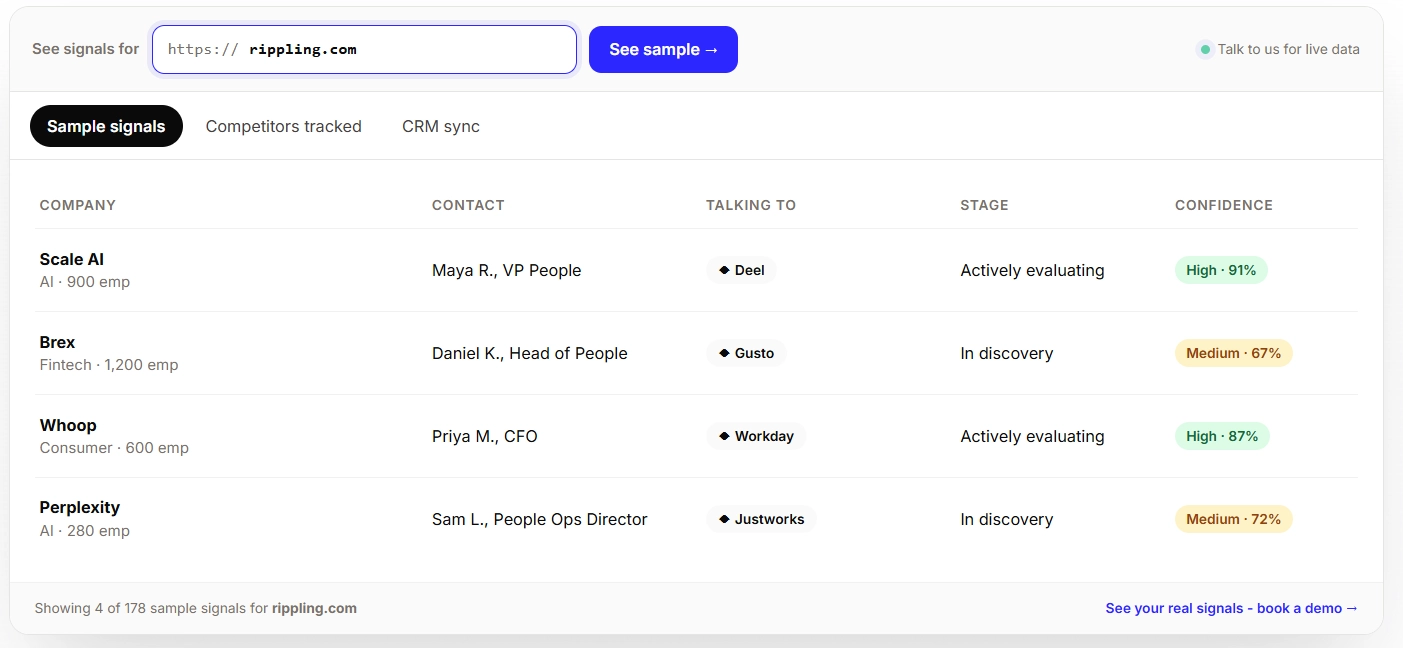
Competitor monitoring on autopilot with Letterdrop, see which competitor reps are active
Subscribe to newsletter
No-BS GTM strategies to build more pipeline in your inbox every week
Related Reading
Some other posts you might find helpful