The Right Way to Track DM Reply Rates for Your Sales Team

Your reps are sending DMs. Some of those DMs are getting replies.
A few of those replies are turning into meetings.
But you have almost no visibility into which messages are working, which reps are landing conversations, and whether what worked last quarter is still working now.
This post is about fixing that.
Why Most Teams Are Not Tracking This
The short answer: native analytics on most social platforms are not built for sales teams.
You can see your own send history. You cannot see aggregate reply rates across your whole team, broken down by sequence, persona, or rep, in a format that is actually useful for coaching.
So most teams default to anecdote. "James is killing it in DMs." Okay, but what is James doing differently? And can you teach the other four reps to do the same?
What to Actually Track
Team-Level Reply Rate
Start here.
What percentage of DMs sent across the team are generating replies? Track this weekly.
A team-level decline over 30 days is usually a signal that messaging is going stale or that sequence saturation is setting in.
Rep-Level Reply Rate
Where are the gaps?
A rep with a 5% reply rate next to a rep with a 22% reply rate is a coaching opportunity sitting right in front of you. The data tells you where to look. The manager's job is to figure out why.
Sequence-Level Reply Rate
Which specific message flows are converting? Break this down by the first message in the sequence, the follow-up pattern, and the messaging angle.
Some sequences work great for inbound-touched prospects and poorly for cold.
Knowing which is which is the whole game.
Reply Quality
Not all replies are equal. A reply that says "please remove me from your list" is technically a reply.
What you want to track is replies that move toward a conversation: questions, interest signals, counter-proposals. Define this clearly for your team so reps are not inflating their numbers.
How to Build This Without a Data Team
You have a few options depending on how much infrastructure you want to build:
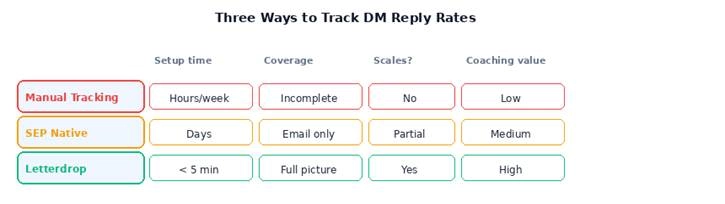
Option 1: Manual Tracking (Not Recommended)
Reps log DM outcomes in a CRM field. You export it monthly and build a report. This works until it does not, which is usually the second week.
Option 2: SEP Native Analytics
Some sales engagement platforms track DM performance alongside email. Coverage is inconsistent and you are usually still missing the full picture, especially if reps are reaching out directly rather than through a sequence.
Option 3: Connected Intelligence Layer
Tools like Letterdrop are purpose-built to give you full visibility into what is happening in your team's DM outbound.
Which warm leads to reach out to and when, your reply rates, sequencing, and more connected straight to your CRM and outbound tools.
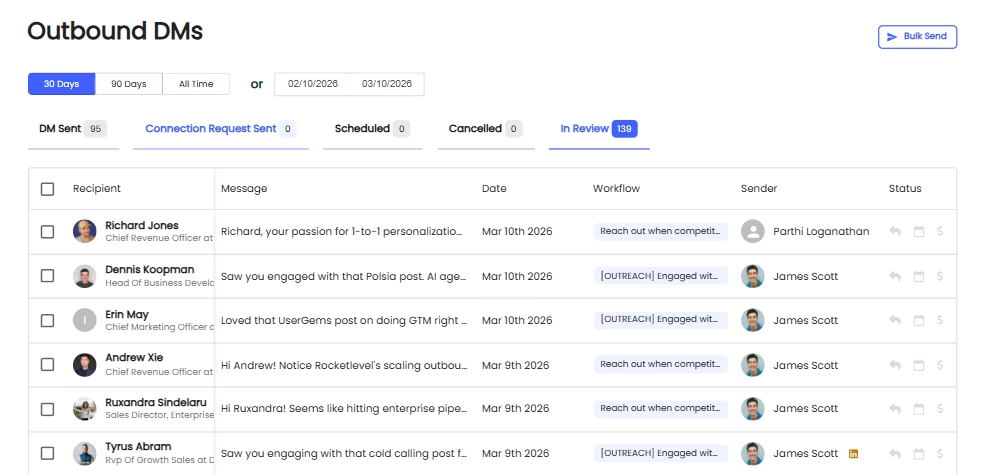
Tracking Outbound DMs in Letterdrop
This is the approach that actually scales. You are not building a reporting system from scratch every quarter. The data is always there when you need it.
What to Do When Reply Rates Drop
Reply rate decline is almost always one of three things: stale messaging, wrong targeting, or both. Here is how to diagnose it:
• If all sequences are declining together, the messaging angle is probably the issue. The approach that felt fresh six months ago is now pattern-matched by buyers. Rewrite the hook.
• If one sequence is declining while others hold, look at the persona and timing. Is the ICP still accurate? Has the outreach timing shifted relative to what is relevant to that buyer right now?
• If a specific rep's numbers are dropping, compare their approach to a top performer. Are they personalizing? Is their timing consistent?
Tracking reply rates does not just tell you what happened. It tells you where to intervene before a slow decline turns into a missed quarter.
Subscribe to newsletter
No-BS GTM strategies to build more pipeline in your inbox every week
Related Reading
Some other posts you might find helpful